

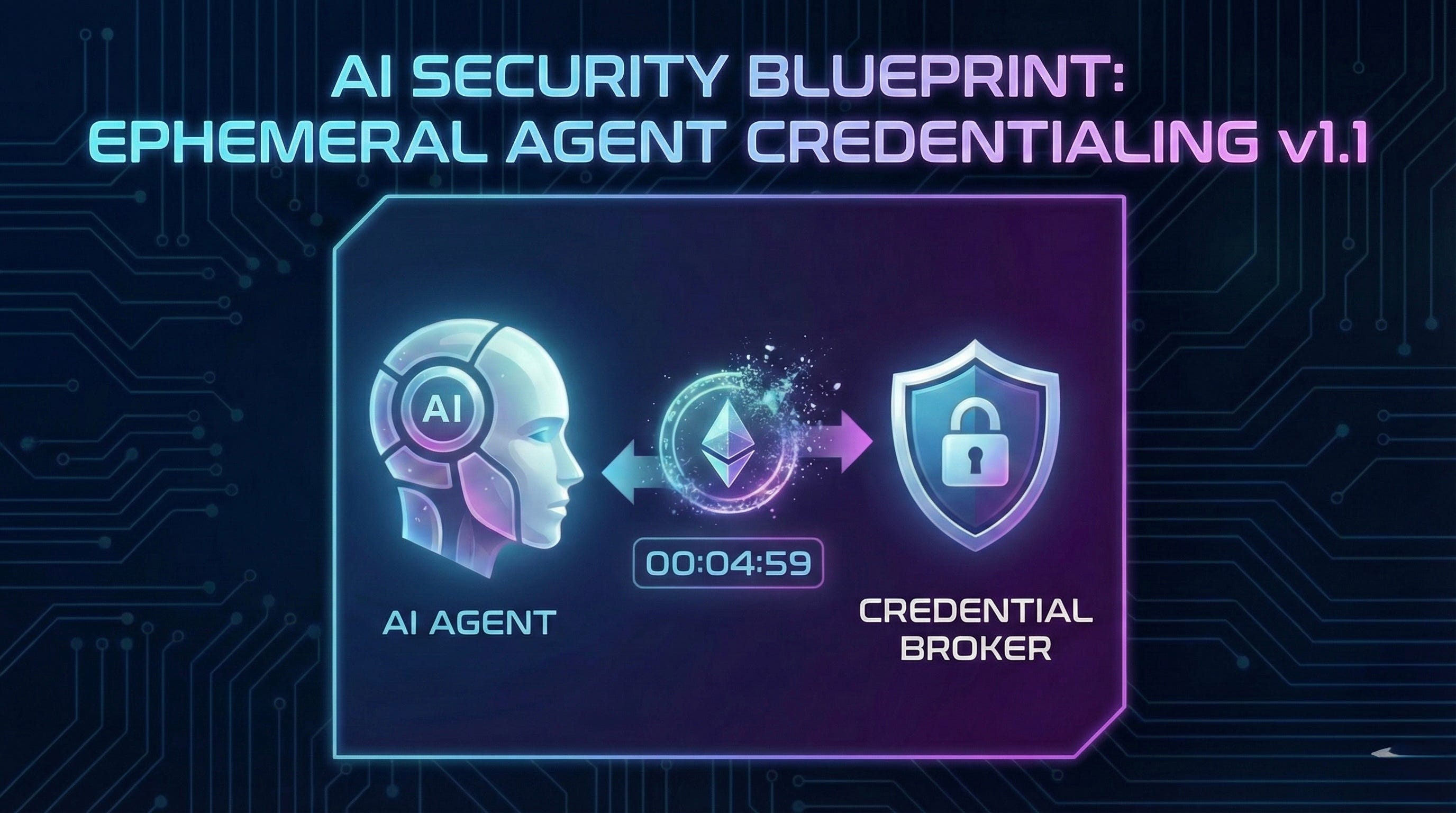
We are building AI agents that can code, deploy infrastructure, and query production databases. Yet, in many architectures I see, these autonomous agents are still holding the digital equivalent of a Master Key: a static, long-lived API token hardcoded into an environment variable.
If that agent gets prompt-injected or hijacked, the attacker doesn’t just get the agent they get the key. And if that key is valid for a year, you have a massive problem.
We need a better standard for agentic security.
I’ve been working on a solution for this in the AI Security Blueprints repository, and today I’m releasing Version 1.1 of the Ephemeral Agent Credentialing pattern.
🛑 The Problem: Static Trust in a Dynamic World
Traditional service accounts assume a static identity. But AI agents are:
Ephemeral: They spin up, do a job, and vanish.
Unpredictable: They might need access to S3 one minute and GitHub the next.
Vulnerable: They process untrusted user input (prompts) directly.
Giving a permanent credential to an entity that parses untrusted input is a security anti-pattern.
🛠 The Solution: Ephemeral Agent Credentialing
This pattern proposes a shift from “Stored Trust” to “Just-in-Time Trust.”
Instead of giving the agent a key, we give the agent a way to prove who it is. The agent then exchanges that proof for a short-lived, scope-down token valid only for the specific task at hand.
The Flow at a High Level:
Boot & Attest: The agent initializes. Instead of loading secrets, it loads a cryptographic identity (like a SPIFFE ID or an OIDC token from its cloud host).
Exchange: When the agent needs to call a tool (e.g., “Search Customer Database”), it sends its identity + the request to a Credential Broker.
Mint: The Broker verifies the identity and mints a token valid for exactly 5 minutes (or the duration of the task) with permissions scoped only to that specific database.
Destruct: Once the task is done, the token expires. If the agent is hijacked 10 minutes later, the attacker finds nothing but expired junk.
🔄 What’s New in v1.1 ?
I’ve just pushed the v1.1 update to the blueprint, which refines the architecture based on early feedback.
Refined Threat Model: We dig deeper into what happens if the Broker is compromised vs. the Agent.
Granular Scoping: Updated definitions on how to scope tokens to individual tools rather than whole APIs.
Auditability: A heavy focus on how to trace actions back to the specific session ID of the agent, not just its generic role.
🧪 I Need Your Eyes on This
Security patterns only survive if they are battle-tested. I am not releasing this as a “finished product,” but as a Request for Comments (RFC).
I need security engineers, AI architects, and DevOps builders to look at this spec and tell me:
Where does this break in your stack?
Is the complexity of a Credential Broker worth the security gain for your use case?
How do we handle the latency of token minting in real-time agent conversations?
Read the Full Pattern (v1.1) on GitHub
Let’s build the security standards for the Agentic Age before the incidents force us to.